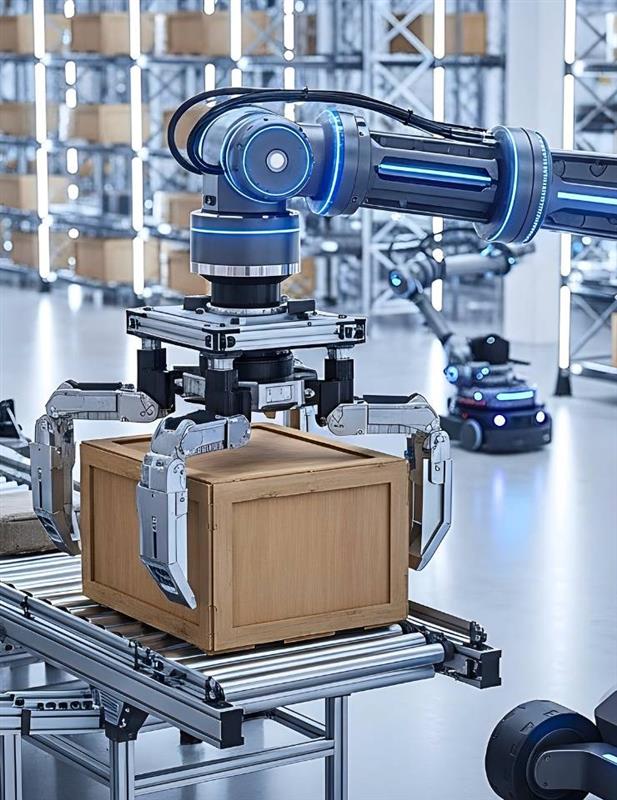
Booktopia partners with BPS Global to deploy autonomous robot technology at its distribution centre

Melbourne, Australia – Booktopia, Australia’s largest online bookstore, has partnered with BPS Global, a leading provider of logistics solutions, to roll out Hai Robotics innovative autonomous robot technology.
As part of a $20 million investment in automation for Booktopia, the robots, combined with a range of other automations, gave the leading retailer the opportunity to improve efficiency and double its product range at its 14,000 sqm distribution centre in Lidcombe, NSW.
In the financial year to June 30, 2020, Booktopia broke all previous sales records and reported a revenue of $165.4m, after the retailer saw a massive increase in sales as a result of the COVID-19 online shopping boom. With no signs of slowing down, Booktopia has revealed it is expecting to turnover $217m in the current (FY21) financial year.
Boasting more than five million customers, Booktopia is proudly a customer-centric organisation and as such has invested in its logistics infrastructure to better serve its growing customer base.
Through working with its integration partner BPS Global, Booktopia has deployed Hai Robotic’s HAIPICK solution. Manufactured by Chinese-based Hai Robotics, the HAIPICK is the world’s first carton picking and double deep autonomous case and tote-handling system. Booktopia will be the first business in Australia to deploy this solution.
The HAIPICK differs from standard autonomous mobile robot solutions as it utilises a telescopic fork which stretches four metres high. This gives the robots the ability to carry cartons as well as individual totes and to bring multiple totes or cartons to pickers in one movement. This enables Booktopia to facilitate the completion of multiple customer orders at one pick station –greatly improving fulfilment and despatch rates for the leading retailer.
This solution has enabled Booktopia to pick, pack and despatch 60,000 units a day, up from its previous capacity of 30,000 order a day.
According to Wayne Baskin, Chief Technology Officer at Booktopia this solution enhances Booktopia’s entire operation.
“Our key driving factor for implementing this technology was efficiency gains for picking and put away. But we’re now finding improvements across our entire operation and we can pick, pack and despatch our orders significantly faster,” Wayne Baskin, Chief Technology Officer at Booktopia said.
According to CEO Tony Nash, Booktopia is driven by a desire to better service its customers. “The foundation of our innovation strategy is to provide our growing customer base with the best and most efficient service we can. By deploying this innovative robot solution, we have doubled our capacity and significantly improved our picking and putaway rates. This gives us the confidence we need to continue to serve our customers,” Tony Nash, CEO at Booktopia said.
As the integration partner, BPS Global has managed the project from inception to go-live. Bruce Drayton, Automation and Robotics Director at BPS Global has been an advisor to Booktopia for the past seven years and has played a key role in optimising the leading retailer’s supply chain operations.
“As one of Australia’s most innovative online retailers, Booktopia is committed to investing in the latest technology to improve its customer experience. The HAIPICK solution provides Booktopia with an impressive 800 per cent efficiency increase. It also reduces dwell time and manual handling for operators as well as provides the Lidcombe site with increased capacity without the need for Booktopia to move or expand,” Bruce Drayton, Automation and Robotics Director at BPS Global said.
“COVID-19 placed immense pressure on e-commerce retailers and we saw volumes reach record heights across the entire retail landscape. We’re thrilled to work with Booktopia on the first ever deployment of this innovative automation solution in Australia. This investment ensures they are well-placed to meet rising demands and continue to service the nation with its favourite books,” Malcolm Druce, Managing Partner at BPS Global said.
“While the rising rental cost of warehouses is becoming a major issue for many companies throughout Australia, our recently launched HAIPICK solution now makes it faster and easier to increase capacity and storage. This solution is the perfect fit for Booktopia and we’re delighted to have our first deployment in the Australian market,” Michael Rolfing, Sales Director for Hai Robotics said.
MORE Blogs

6 Signs Your Grocery Warehouse Is Ready for Automation
Grocery and convenience-store supply chains operate under intense pressure: wide product ranges, short lead times, frequent replenishment and little room for inventory errors. As order volumes grow, manual processes can become the biggest constraint on service quality and profitability.
Warehouse automation is not simply about replacing labour with robots. It is about building a more resilient operation — one that can manage complexity, use space efficiently and respond quickly to changing demand. Here are six signs that your grocery warehouse may be ready for automation.
1. Your SKU mix is becoming harder to manage
Grocery operations often handle thousands of SKUs, from fast-moving essentials to bulky, irregular or temperature-sensitive products. As the assortment expands, manual picking and stock control become increasingly difficult.
Common warning signs include:
• Frequent mis-picks or stock discrepancies
• High-demand items stored in inconvenient locations
• Congested aisles and longer picker travel distances
• Difficulty handling mixed-case or split-case orders
Automation can introduce goods-to-person workflows, intelligent slotting and real-time inventory visibility into warehouse operations, helping teams pick more accurately while reducing unnecessary travel.
2. Your facility is running out of usable space
A warehouse layout that worked well in the past may no longer suit today’s product range and order profile. Static racking, excessive aisles and underused vertical space can limit storage capacity without delivering proportional productivity gains.
Rather than relocating or expanding a facility, operators can reassess how space is used. Automated storage and retrieval systems, high-density racking and flexible goods-to-person layouts can increase storage capacity within the same footprint while improving accessibility to fast-moving items.
3. Labour availability is affecting performance
Labour shortages, absenteeism and high turnover place significant pressure on warehouse teams. When experienced staff leave, productivity and process consistency can decline quickly.
Automation helps reduce dependence on repetitive manual tasks, allowing employees to focus on higher-value activities such as quality control, exception handling and process improvement. It also makes it easier to maintain stable throughput during peak seasons or staffing gaps.
4. Errors are affecting customers and costs
In grocery logistics, an incorrect pick can mean an empty shelf, a delayed delivery or unnecessary returns. Manual counting and paper-based processes also make it harder to maintain accurate inventory records.
Automated systems can improve picking accuracy, strengthen traceability and provide clearer visibility of stock levels, replenishment needs and order status. Integrated with a warehouse management system or ERP platform, these insights support better planning and faster corrective action.
5. Cold-chain and expiry management is becoming complex
Grocery warehouses often handle chilled, frozen and fresh products with strict temperature, shelf-life and traceability requirements. Manual monitoring and stock rotation can be difficult to sustain as volumes and product varieties increase.
Automation can support more disciplined first-in, first-out (FIFO) or first-expired, first-out (FEFO) workflows, improve visibility of batch and expiry data, and reduce the risk of products being overlooked or dispatched beyond their usable period.
6. Growth is creating operational bottlenecks
If seasonal promotions, new store openings or online-order growth regularly overwhelm your warehouse, the issue may not be insufficient staff — it may be an operating model that cannot scale efficiently.
Automation provides a more scalable foundation. Modular systems can be expanded gradually, while software-driven workflows help maintain consistent performance as volumes rise. This enables grocery operators to grow without sacrificing service levels or control.
From manual constraints to scalable operations
Warehouse automation should begin with a clear assessment of current workflows, product profile, space utilisation, order patterns and growth plans. The right solution is not necessarily the most complex one; it is the one that addresses the operation’s specific constraints while remaining flexible for the future.
For grocery and convenience-store operators, automation can turn a congested, labour-dependent warehouse into a more accurate, space-efficient and scalable supply-chain hub.
With more than 30 years of experience in logistics technology, BPS Global Australia provides solution design, consultancy and logistics automation services. We can assess suitable warehouse automation applications based on each company's operational needs and combine storage equipment with system integration to develop automation solutions tailored to site conditions. From needs analysis and equipment configuration to implementation, we help businesses ensure that automation investments align with business objectives and deliver sustained improvements in operational efficiency.
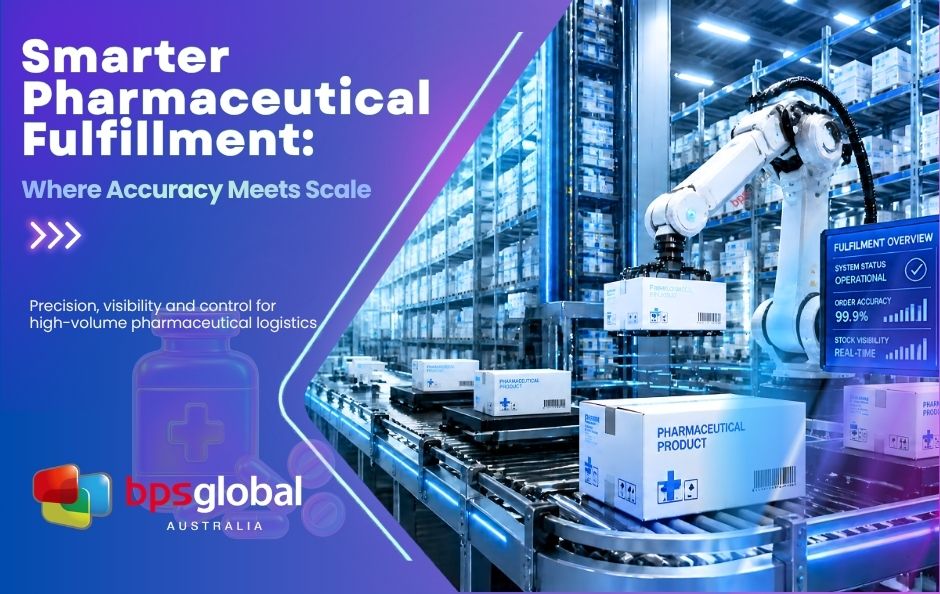
Smarter Pharmaceutical Fulfilment: Where Accuracy Meets Scale
In pharmaceutical logistics, a delayed order is inconvenient. An inaccurate one can be far more serious. That is why pharmaceutical distributors, pharmacy chains, and healthcare e-commerce businesses need fulfilment operations built around precision, visibility, and control — not speed alone.
BPS Global Australia helps these businesses modernise their warehouses with intelligent automation that supports high-volume fulfilment while protecting the standards the industry demands.
The Real Pressure on Pharma Warehouses
Pharmaceutical fulfilment is rarely straightforward. A single operation may handle prescription medicines, wellness products, medical devices, personal-care items, and temperature-sensitive stock—all with different handling rules and customer expectations.
Meanwhile, the way patients and consumers purchase healthcare products is changing. More orders now originate online, with expectations for rapid dispatch, accurate delivery updates, and convenient collection options. Traditional manual warehouses can meet these needs at low volume, but they become harder to manage as order volumes, SKU counts, and channel complexity increase.
The challenge is not simply to move more goods. It is to move the right goods, in the right condition, with complete operational confidence.
Automation That Supports Compliance and Control
For pharmaceutical businesses, automation must do more than increase throughput. It should strengthen the controls that keep operations safe and accountable.
BPS Global Australia focuses on connecting robotics with intelligent workflow management, so that every task—from replenishment to picking and dispatch—can be coordinated consistently across the warehouse.
This enables operations to better manage:
• Product traceability throughout the fulfilment journey
• Stock rotation and expiry-related handling requirements
• Batch-level visibility across inventory and order workflows
• Controlled picking processes that reduce the risk of human error
• Clear operational data for planning, auditing, and continuous improvement
By bringing goods to operators rather than requiring staff to search for them, goods-to-person automation also creates a more structured and repeatable picking environment.
Designed Around Pharmaceutical Order Profiles
No two pharmaceutical warehouses operate in exactly the same way. Some prioritise rapid single-item e-commerce fulfilment; others focus on replenishing pharmacy branches, managing bulky stock, or supporting urgent orders alongside routine demand.
BPS Global Australia takes an operation-first approach. We assess how products flow through the facility, where bottlenecks occur, and which order types drive the greatest operational pressure. The resulting solution is designed around those realities.
Typical applications include:
• E-commerce fulfilment for direct-to-consumer healthcare orders
• Pharmacy replenishment across retail and clinic networks
• High-density storage for growing SKU ranges
• Multi-channel fulfilment combining online, retail, and wholesale demand
• Returns handling to recover value and maintain inventory accuracy
Growth Without Disruption
One of the biggest concerns for pharmaceutical businesses considering automation is scalability. A solution that works today may not support tomorrow’s volumes, new product categories, or additional fulfilment channels.
Modular robotics offers a practical answer. Businesses can automate a defined area first—such as e-commerce picking or high-density storage—then expand robot fleets, workstations, and storage capacity as demand evolves.
This phased approach reduces upfront risk and allows automation investment to keep pace with business growth.
From Efficiency to Competitive Advantage
Automation should not be viewed simply as a cost-saving exercise. For pharmaceutical businesses, it can become a foundation for better customer service, stronger inventory control, and greater resilience during demand peaks.
With BPS Global Australia, pharmaceutical operators can build fulfilment operations that are accurate by design, adaptable by nature, and ready to scale with the future of healthcare commerce.

How Can AMRs Be Applied in Warehouses?
A batch of goods often undergoes multiple transfers from receiving, putaway and picking to outbound shipping. If every stage relies on staff transporting goods back and forth with hand trucks, it not only consumes significant transport time but also slows down picking and shipping operations. Autonomous Mobile Robots (AMRs) can automatically deliver goods to designated locations according to task instructions, helping connect different warehouse operations, reducing repetitive handling and enabling smoother goods flow.
How Do AMRs Work?
Common AMR models combine laser sensors, cameras or other sensing devices to identify their surroundings, position themselves and plan routes. Some models can slow down, stop or reroute according to predefined rules when they detect people or obstacles.
Compared with material-handling equipment that relies on fixed guidance paths, AMRs can autonomously plan routes based on facility maps and sensor data. However, their actual performance still depends on equipment design, navigation configuration and site conditions.
Four Key Warehouse Applications of AMRs
1. Goods transportation: AMRs can transport goods from the receiving area to storage areas, as well as move picked goods to packing or outbound locations, reducing employees’ repetitive cross-zone trips with hand trucks.
2. Goods-to-person picking: In a goods-to-person picking process, AMRs can deliver totes or designated shelving units to picking workstations. Employees can then focus on picking, verification and packing without frequently entering and exiting storage areas. This approach is particularly suitable for operations with a wide range of SKUs, high order volumes and substantial transport needs between picking and storage locations.
3. Automated replenishment: When picking locations require stock replenishment, AMRs can transport backup inventory to designated locations based on tasks assigned by the system or staff. With inventory data and replenishment rules in place, this helps reduce conflicts between replenishment and picking activities.
4. Inter-process material transfer: AMRs can transport materials between workstations such as receiving, inspection, processing, and packing according to task assignments, reducing manual handling and waiting time during handovers. Processes with repetitive transport routes and clear material flows are particularly suitable for automation.
How Much Efficiency Can AMRs Deliver? What Should Be Assessed Before Implementation?
The benefits of AMRs should not be measured solely by travel speed. Businesses should also assess whether they can reduce handling labour hours, improve delivery consistency and allow employees to focus on picking, inspection, exception handling and other value-added tasks.
OMRON Robotics published a case study in 2025 involving its facility in Pleasanton, California. At the time, technicians had to manually transport parts between storage areas, assembly lines and workstations, with inefficient transport affecting assembly and testing operations. OMRON subsequently deployed OL-450S AMRs to automatically transport different types of goods and assign transport tasks through software, without modifying aisles or workstation layouts. The project completed hundreds of transport tasks per month, freed up more than 20 hours of technician time per week, and improved material-handling productivity by 30%*.
*The above reflects results from a specific facility. Improvements at other warehouses will depend on site conditions, handling requirements, and system configuration.
Before purchasing AMRs, businesses should record the number of daily transport tasks, time required for each transfer, and manpower involved. They should also confirm whether aisle widths, turning space, floor evenness, gradients, pedestrian-vehicle interaction, and the weight of racks, totes, and goods meet equipment requirements. In addition, AMRs should be connected to a Warehouse Management System (WMS), Warehouse Execution System (WES), or Warehouse Control System (WCS) to receive transport tasks, report status, and handle exceptions. The systems that need to be integrated will largely depend on the company’s existing infrastructure and workflows.
In general, businesses can begin with a pilot in areas with high transport frequency, repetitive routes, and easily measurable results, then compare efficiency and process performance before and after implementation.
Case Study: Automated Material-Handling Solution for a Hong Kong Government Engineering Department
To address the storage, picking and retrieval needs for spare parts, BPS Global Australia provided an automated material-handling solution for Hong Kong’s Electrical and Mechanical Services Department. The solution combines AI-powered AMRs, smart retrieval cabinets, and a Warehouse Control System (WCS), with the WCS integrated into the client’s IT systems.
When a relevant order is triggered, the system automatically generates storage and retrieval instructions. Users can retrieve the required spare parts from the smart retrieval cabinet simply by entering a password. Through this solution, spare-part storage and retrieval processes operate in a more systematic manner, reducing reliance on manual item-by-item handling while helping save labour costs and storage space.
This project also demonstrates that, for AMRs to deliver their full benefits, they must work in coordination with intelligent storage equipment and information systems rather than operating solely as transport robots.
From AMR Assessment to Warehouse Automation Solutions
AMRs can improve goods transportation, goods-to-person picking and inter-process material transfer. However, achieving genuine improvements in warehouse efficiency also requires alignment with facility layout, operational workflows and information systems.
With more than 20 years of experience in logistics technology, BPS Global Australia provides solution design, consultancy and logistics automation services. We can assess suitable AMR applications based on each company’s operational needs and combine storage equipment with system integration to develop automation solutions tailored to site conditions. From needs analysis and equipment configuration to implementation, we help businesses ensure that automation investments align with business objectives and deliver sustained improvements in operational efficiency.
CONTACT US
Talk to Our Industry Experts About Your Needs