Bridging the gap between Chinese innovation and Australian operations
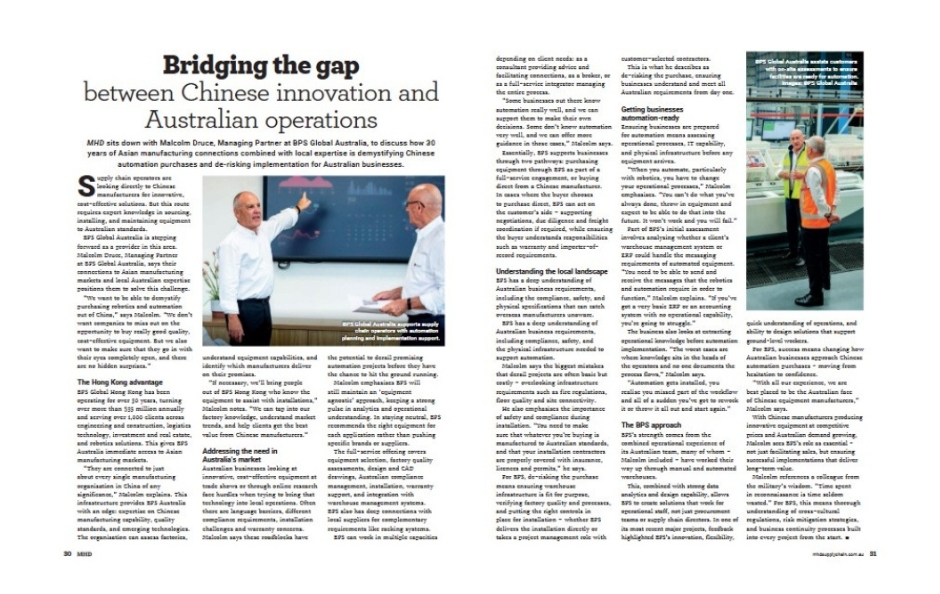
MHD Magazine (March 2026)
MHD sits down with Malcolm Druce, Managing Partner at BPS Global Australia, to discuss how 30 years of Asian manufacturing connections combined with deep local expertise is demystifying Chinese automation purchases and de-risking implementation for Australian businesses.
Supply chain operators are looking directly to Chinese manufacturers for innovative, cost-effective solutions. But this route requires expert knowledge in sourcing, installing, and maintaining equipment to Australian standards.
BPS Global Australia is stepping forward as a leader in this area. Malcolm Druce, Managing Partner at BPS Global Australia, says their connections to Asian manufacturing markets and local Australian expertise positions them to solve this challenge.
“We want to be able to demystify purchasing robotics and automation out of China," says Malcolm. "We don't want companies to miss out on the opportunity to buy really good quality,cost-effective equipment. But we also want to make sure that they go in with their eyes completely open, and there are no hidden surprises."
The Hong Kong advantage
BPS Global Hong Kong has been operating for over 30 years, turning over more than $35 million annually and serving over 1,000 clients across engineering and construction, logistics technology, investment and real estate,and robotics solutions. This gives BPS Australia immediate access to Asian manufacturing markets.
“They are connected to just about every single manufacturing organisation in China of any significance," Malcolm explains. This infrastructure provides BPS Australia with an edge: expertise on Chinese manufacturing capability, quality standards, and emerging technologies. The organisation can assess factories, understand equipment capabilities, and identify which manufacturers deliver on their promises.
“If necessary, we'll bring people out of BPS Hong Kong who know the equipment to assist with installations,” Malcolm notes. “We can tap into our factory knowledge, understand market trends, and help clients get the best value from Chinese manufacturers.”
Addressing the need in Australia’s market
Australian businesses looking at innovative, cost-effective equipment at trade shows or through online research face hurdles when trying to bring that technology into local operations. Often there are language barriers, different compliance requirements, installation challenges and warranty concerns. Malcolm says these roadblocks have the potential to derail promising automation projects before they have the chance to hit the ground running.
Malcolm emphasises BPS will still maintain an ‘equipment agnostic’ approach, keeping a strong pulse in analytics and operational understanding. Instaying neutral, BPS recommends the right equipment for each application rather than pushing specific brands or suppliers.
The full-service offering covers equipment selection, factory quality assessments, design and CAD drawings, Australian compliance management, installation, warranty support, and integration with warehouse management systems. BPS also has deep connections with local suppliers for complementary requirements like racking systems.
BPS can work in multiple capacities depending on client needs: as a consultant providing advice and facilitating connections, as a broker, or as a full-service integrator managing the entire process.
"Some businesses out there know automation really well, and we can support them to make their own decisions. Some don't know automation very well, and we can offer more guidance in those cases," Malcolm says.
Essentially, BPS supports businesses through two pathways: purchasing equipment through BPS as part of a full-service engagement, or buying direct from a Chinese manufacturer. In cases where the buyer chooses to purchase direct, BPS can act on the customer’s side – supporting negotiations, duediligence and freight coordination if required, while ensuring the buyer understands responsibilities such as warranty and importer-of-record requirements.
Understanding the local landscape
BPS has a deep understanding of Australian business requirements,including the compliance, safety, and physical specifications that can catch overseas manufacturers unaware.
BPS has a deep understanding of Australian business requirements,including compliance, safety, and the physical infrastructure needed to support automation.
Malcolm says the biggest mistakes that derail projects are often basic butcostly – overlooking infrastructure requirements such as fire regulations,floor quality and site connectivity.
He also emphasises the importance of safety and compliance duringinstallation. “You need to make sure that whatever you’re buying is manufactured to Australian standards, and that your installation contractors are properly covered with insurance, licences and permits,” he says.
For BPS, de-risking the purchase means ensuring warehouse infrastructure is fit for purpose, verifying factory quality and processes, and putting the right controls in place for installation – whether BPS delivers the installation directly or takes a project management role with customer-selected contractors.
This is what he describes as de-risking the purchase, ensuring businesses understand and meet all Australian requirements from day one.
Getting businesses automation-ready
Ensuring businesses are prepared for automation means assessing operational processes, IT capability, and physical infrastructure before any equipment arrives.
"When you automate, particularly with robotics, you have to change your operational processes," Malcolm emphasises. "You can't do what you've always done, throw in equipment and expect to be able to do that into the future. It won't work and you will fail."
Part of BPS's initial assessment involves analysing whether a client's warehouse management system or ERP could handle the messaging requirements ofautomated equipment. “You need to be able to send and receive the messages thatthe robotics and automation require in order to function," Malcolm explains. "If you've got a very basic ERP or an accounting system with no operational capability, you're going to struggle.”
The business also looks at extracting operational knowledge before automation implementation. "The worst cases are where knowledge sits inthe heads of the operators and no one documents the process flows,” Malcolm says.
“Automation gets installed, you realise you missed part of the workflow and all of a sudden you've got to rework it or throw it all out and start again."
The BPS approach
BPS's strength comes from the combined operational experience of its Australian team, many of whom – Malcolm included – have worked their way up through manual and automated warehouses.
This, combined with strong data analytics and design capability, allows BPS to create solutions that work for operational staff, not just procurement teams or supply chain directors. In one of its most recent major projects, feedback highlighted BPS's innovation, flexibility, quick understanding of operations, and ability to design solutions that support ground-level workers.
For BPS, success means changing how Australian businesses approach Chinese automation purchases - moving from hesitation to confidence.
"With all our experience, we are best placed to be the Australian face of Chinese equipment manufacturers," Malcolm says.
With Chinese manufacturers producing innovative equipment at competitive prices and Australian demand growing, Malcolm sees BPS's role as essential -not just facilitating sales, but ensuring successful implementations that deliver long-term value.
Malcolm references a colleague from the military’s wisdom. “Time spent in reconnaissance is time seldom wasted.” For BPS, this means thorough understanding of cross-cultural regulations, risk mitigation strategies, and business continuity processes built into every project from the start.
MORE Blogs

Pallet Shuttle System | High-Density Storage Solutions
The Pallet Shuttle System is one of the core solutions for achieving highly efficient pallet handling in modern warehouse management. By utilising automated machinery running on racking rails, it drastically reduces the need for manual operations and forklift entry into storage aisles. BPS Global Australia provides one-stop shuttle system planning, installation, and maintenance services, helping enterprises maximise storage density and operational efficiency while saving valuable space and labor costs.
Operating Principles & Core Advantages
The pallet shuttle travels automatically along the racking rails, receiving tasks via wireless commands to transport pallets to designated locations. Unlike traditional warehousing, the shuttle car operates seamlessly within multi-tier racking designs, enabling flexible vertical and horizontal routing. The system can be configured to execute First-In, First-Out (FIFO) or Last-In, First-Out (LIFO) retrieval models based on your business needs, highly enhancing the flexibility of logistics turnover.
The system features a highly modular design. Industrial-grade lithium batteries, drive modules, and sensor devices can all be replaced independently without returning the entire machine to the factory for repairs. Furthermore, it integrates flawlessly with your Warehouse Management System (WMS) and Warehouse Control System (WCS) to synchronise real-time inventory data and eliminate human errors.
For enterprises, adopting a high-efficiency pallet handling solution delivers three substantial benefits:
- Maximise Storage Density: Fully utilises the vertical height of the warehouse, accommodating significantly more pallets within the same footprint to achieve ultimate high-density storage.
- Reduce Operational Costs: Decreases reliance on manual labor and traditional forklifts, driving long-term savings in energy and manpower expenses.
- Enhance Operational Efficiency: Automated workflows shorten pallet retrieval times, accelerating order processing and inbound/outbound fulfillment.
Pallet Shuttle Systems: Model Lineup
BPS offers a diverse range of high-efficiency pallet handling models tailored to the specific needs of various industries, including e-commerce, cold chain, and manufacturing:
Smart 4-Direction Shuttle Robot
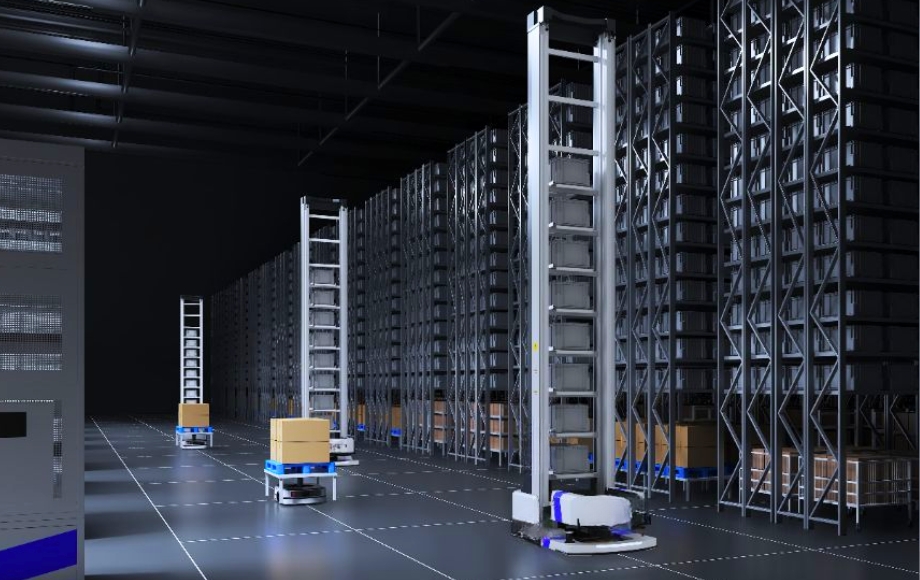
The 4-direction shuttle is a highly automated intralogistics equipment capable of traveling freely along both longitudinal (X-axis) and transverse (Y-axis) racking rails. Equipped with track-changing capabilities, it maneuvers flexibly in all four directions. As the core equipment of modern automated warehouses, it significantly boosts space utilisation and throughput efficiency.
- Integrated Storage & Retrieval: Delivers goods directly to the designated slot via system commands without the need for secondary handling.
- Intelligent Dynamic Management: Built-in control systems and warehouse mapping optimize travel paths and update inventory locations in real-time.
- 3D Dense Storage: Tailored configurations and combinations based on the warehouse environment to maximise space utilisation.
- High Scalability: Flexibly add more shuttle cars as your business grows to meet phased expansion needs.
Shuttle Robot Special Hoist (Vertical Conveyor)
- High-Speed Operation: Delivers highly efficient vertical transport, allowing shuttle robots to maintain peak operational speeds.
- Integrated Control: Connects with the WCS for real-time cargo data exchange, achieving unified management of storage and production.
- Strong Docking Capability: Interfaces seamlessly with various shuttle robots and cargo types.
- Simple & Durable Structure: Designed for logical simplicity, low energy consumption, minimal rail wear, and high durability.
- 4-Way Movement & In-Place Track Changing: Can retrieve and store goods at any location on the same horizontal plane.
- Multi-Tier Handling: Equipped with specialized picking tools to achieve high-efficiency storage and retrieval across 1 to 5 vertical tiers.
- Real-Time Monitoring: Centrally coordinated by the WCS to monitor coordinates, traveling speed, and battery levels in real-time.
- Flexible Processing Capacity: Supports multi-device collaborative operations, boosting throughput by up to 3 times compared to traditional models.
- High-Speed Precise Positioning: Fast traveling speed with rapid telescopic forks for automated inbound/outbound handling of totes and cartons.
- Flexible Material Supply: Automatically retrieves goods based on real-time production line demands, revolutionizing traditional workflows.
- Advanced Track-Changing Technology: Switches track flexibly, increasing transport speeds several times over traditional suspension chains.
- Frees Up Floor Space: Travels stably on overhead tracks, saving precious factory floor space.
Cold Storage Dedicated Shuttle Robot
Specifically engineered for low-temperature cold storage environments, operating reliably at temperatures as low as -35°C. It is the ideal automation solution for cold chain warehouses.
- 4-Way Smart Driving: Travels freely across intersecting 3D racking rails. Real-time management by the central system drastically reduces error rates.
- Unmanned Operation: Fully automated goods distribution within the warehouse eliminates the need for staff to frequently enter freezing environments, mitigating occupational safety risks.
- Maximised Energy Efficiency: High-density storage design increases inventory per unit area, diluting and lowering the refrigeration energy consumption per unit of cargo.
Note: Every model supports customised adjustments, including load capacity, travel speed, and communication protocols, ensuring perfect integration with clients' existing facilities.
Frequently Asked Questions (FAQ)
Q1: Which industries are best suited for Pallet Shuttle Systems?
They are ideal for e-commerce logistics, frozen foods, pharmaceutical warehousing, manufacturing raw material storage, and third-party logistics (3PL). For the food and pharmaceutical industries, which require strict adherence to First-In, First-Out (FIFO) to manage product shelf life, the shuttle system provides the most efficient and precise high-density storage solution.
Q2: Which automated systems can the shuttle system integrate with?
The shuttle system boasts high compatibility and can be seamlessly integrated with automated stacker cranes, conveyor lines, AGV/AMRs, and WMS/WCS platforms to build an end-to-end smart warehousing solution.
Q3: What precautions should be taken when installing and operating a pallet shuttle?
Before deployment, we recommend an expert assessment of racking load-bearing capacity, floor flatness, and power configurations. During daily operations, routine checks on battery health and rail cleanliness are necessary to ensure the long-term stability of efficient pallet handling.
Q4: Is the system flexible enough for future business expansion?
Yes. The entire system features a modular design. You can progressively add more shuttle cars or expand the rail network in response to business growth. This offers immense flexibility without requiring massive, one-off upfront investments.

Warehouse Automation Explained: From Conveyors to Robots What Australia Logistics Can’t Afford to Ignore
Handling 10,000 orders in a traditional warehousemay require 50 workers pulling overnight shifts. In contrast, a warehouseautomation system can complete the same workload with just over a dozen staff —within regular office hours.
The difference isn’t manpower; it’s warehouseautomation.
With Hong Kong’s soaring land prices and risingoperating costs, traditional warehouse operations are struggling to keep upwith fast-moving e-commerce and supply chain demands.
So, what types of warehouse automation systems areavailable in Australia? And how can they solve real operational challenges?This guide breaks it down.
Common Warehouse Automation Systems in Australia
To improve efficiency and maximise ROI, businessesneed a clear understanding of how different warehouse automation solutions work,and where they deliver the most value.
1. Conveyor Systems in Warehouse Automation
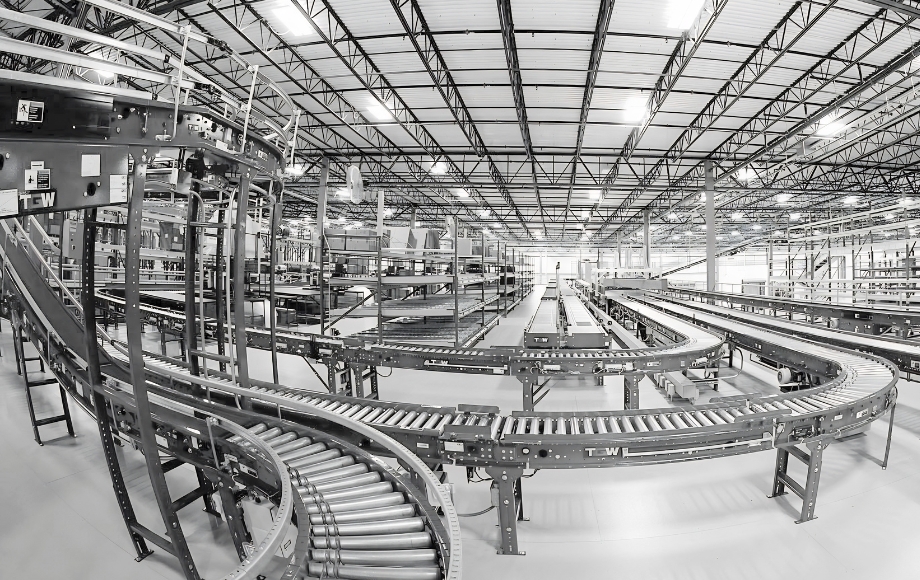
Conveyor systems are one of the most widely usedwarehouse automation solutions, designed for point-to-point and long-distancematerial handling.
In traditional warehouses, workers spendsignificant time walking and transporting goods. With conveyors, items moveautomatically between receiving, storage, picking and packing zones.
Modern automated conveyor systems integrate barcodescanning and weight detection to identify and remove sorting errors — improvingboth accuracy and throughput.
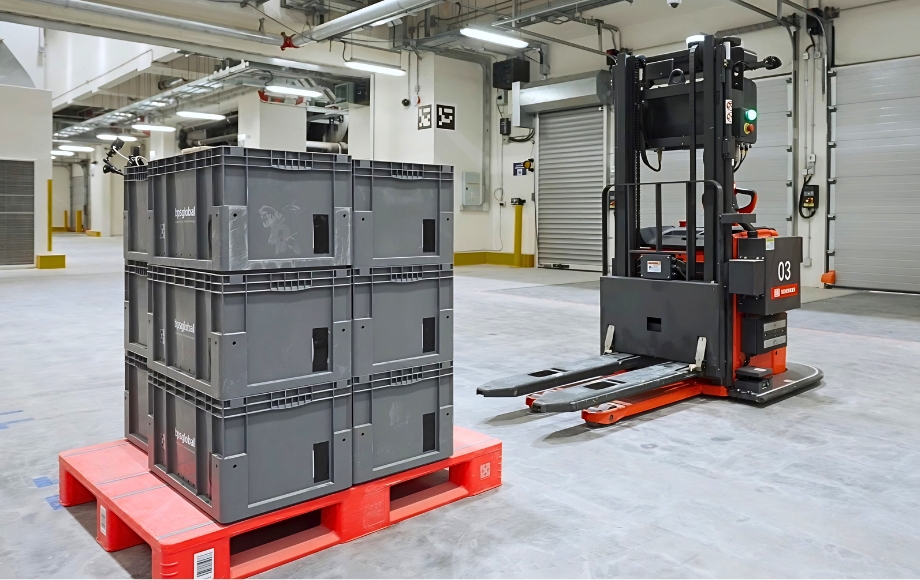
2. AMR Warehouse Robots & Vision-GuidedForklifts (AGF)
AMR warehouse robots (Autonomous Mobile Robots) andAGF (Automated Guided Forklifts) are rapidly transforming warehouse operationsin Hong Kong.
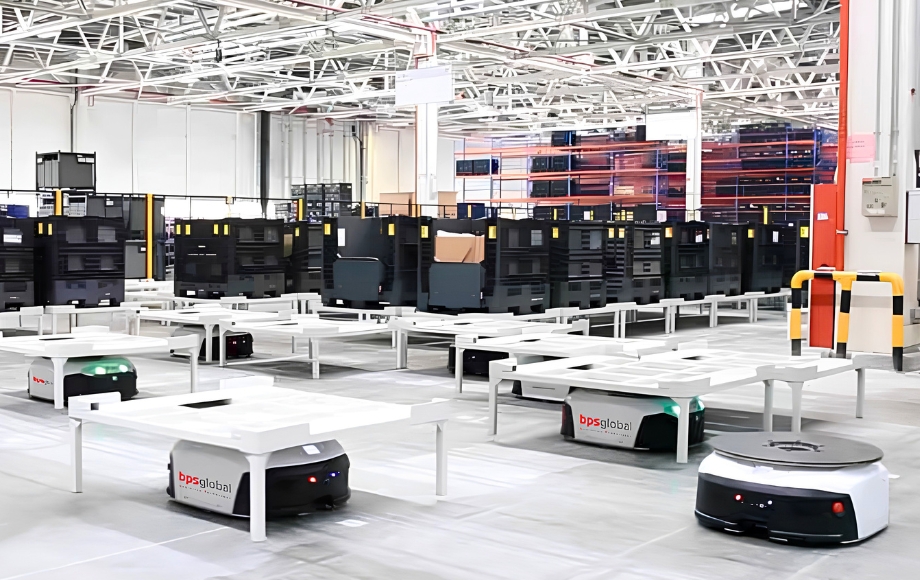
Unlike traditional AGVs that rely on fixed tracks,AMRs use real-time navigation and environmental sensing to move freely andavoid obstacles. This makes them ideal for dynamic warehouse environments.
AMRs enable a “goods-to-person” picking system,where robots deliver items directly to operators — reducing walking time andboosting productivity.
Meanwhile, AGF forklifts automate pallet transportand high-risk handling tasks. They improve warehouse safety while enabling 24/7automated operations, reducing reliance on manual labor.
3. AS/RS Australia: Automated Storage and RetrievalSystems
With limited land availability, AS/RS (AutomatedStorage and Retrieval Systems) in Hong Kong are essential for maximising space.
These systems use high-rise racking, shuttlesystems and stacker cranes to achieve high-density storage — often severaltimes greater than traditional warehouse setups.
Integrated with WMS and WCS, ASRS systems automateinventory storage and retrieval, reducing manual handling and improvingaccuracy.
For businesses managing large SKU volumes and highturnover rates, AS/RS is a critical warehouse automation investment.
4. Mezzanine Systems for Warehouse Space Optimisation
A warehouse mezzanine system creates additionalstorage levels within existing facilities, maximising vertical space withoutmajor structural changes.
This is especially useful in Hong Kong’s olderindustrial buildings. When combined with lifts or automation equipment,mezzanines can significantly increase storage capacity at a relatively lowcost.
By combining these warehouse automationtechnologies, businesses can overcome three key challenges in Hong Kong: highrent, labor shortages and operational inefficiencies.
Case Study: Warehouse Automation in Australia
A major e-commerce company operating a 40,000 sq.ft. warehouse in Kwai Chung faced rapid order growth, with peak volumesexceeding 10,000 orders per day.
Manual picking using paper lists led to frequenterrors, long working hours and high staff turnover — common challenges intraditional warehouse operations.
To improve efficiency, the company implemented acustom warehouse automation solution with BPS:
- Installed mezzanine racking to increase storage and picking capacity
- Deployed AMR warehouse robots for a goods-to-person picking system
- Integrated automated conveyor systems for seamless packing and dispatch
Results of Warehouse Automation Implementation
The transformation delivered measurable results:
- 99.9% picking accuracy
- 3× increase in order processing efficiency
- 40% reduction in labour requirements
Warehouse staff shifted from manual picking tosystem operation and quality control —improving both productivity and jobsatisfaction.
BPS Global Australia: Warehouse AutomationExperts in Australia
Successful warehouse automation in Australia requires more than just equipment, it demands expert planning, systemintegration and technology alignment.
BPS Global Australia provides end-to-endwarehouse automation solutions, including:
- Automation strategy and data analysis
- Equipment selection (AMR, AGF, AS/RS, conveyors)
- Mezzanine system design
- Full system integration (WMS/WCS)
- On-site implementation and support
Upgrade yourwarehouse with the right automation strategy.
Contact BPS Australia today to start your warehouse automation journey andstay ahead in Hong Kong’s competitive logistics landscape.
Goods-to-Person vs Person-to-Goods: The Key Choice for Boosting Warehouse Efficiency
Are your warehouse staff constantly walking back and forth every day, spending excessive time locating and picking items — yet still struggling to keep up with growing order volumes? The root issue often isn't manpower, but whether your picking model suits your business.
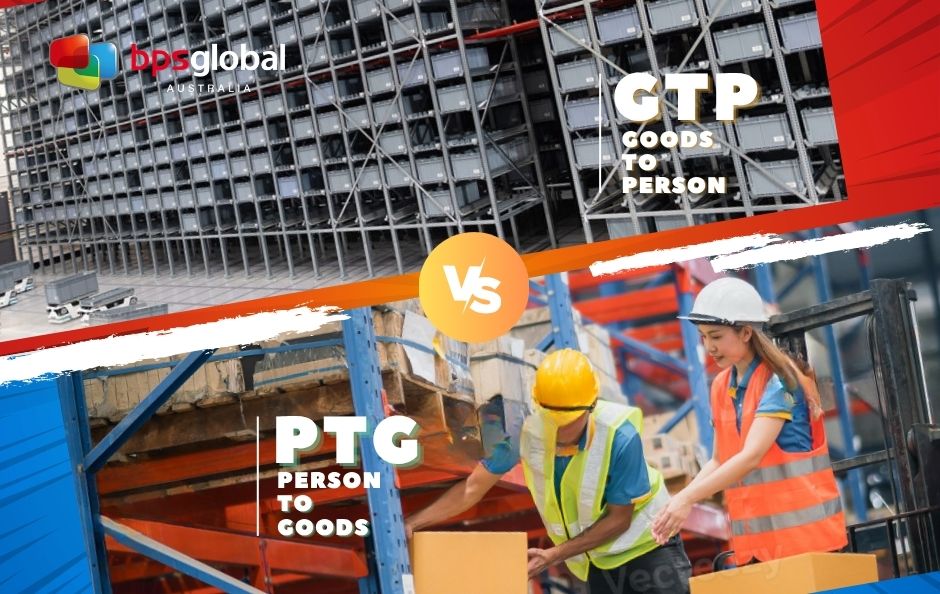
"Goods-to-Person" (GTP) refers to automated systems delivering items directly to a stationary picking workstation, while "Person-to-Goods" (PTG) requires workers to travel to storage locations to pick items. Let's break down these two approaches to help you determine which model can maximise your operational performance.
Person-to-Goods vs Goods-to-Person: A Comprehensive Comparison
With high rents and ongoing labour shortages in Hong Kong, choosing the right picking model has a major impact on operating costs.
A Goods-to-Person system replaces manual picking with automation, significantly improving efficiency while maximising limited warehouse space — making it especially suitable for growing businesses.
While Person-to-Goods has a lower entry barrier, increasing order volumes will gradually drive up labour and space costs, eroding profit margins.
Key Differences
Technology Behind Goods-to-Person Systems
It's important to note that GTP is not a single piece of equipment, but a combination of automation solutions. Depending on warehouse size, SKU count, and order profiles, businesses can choose the most suitable setup:
- Grid-based Systems
Robots transport entire shelves or pallets to picking stations. These systems require less rigid rack structures, are faster to deploy, and allow multiple related SKUs on the same shelf — improving picking efficiency. - Shuttle Systems
Extract individual totes and deliver them to workstations before returning them. With standardised structures, they support extremely high speed and throughput — ideal for high-frequency operations with relatively concentrated SKUs. - Robotic GTP with Fixed Racks
Robots retrieve totes from pre-designed fixed racking systems. These solutions maximise vertical space (up to 30 feet or more), making them ideal for high-SKU, high-density storage environments. - Carousel Systems
Use horizontal or vertical rotation to bring items to operators. They are ideal for space-constrained warehouses and help improve picking accuracy while reducing manual errors.
Each architecture has its strengths in space utilisation, speed, and investment cost. Businesses should choose based on their order structure, SKU characteristics and future scalability — not just the level of automation.
How to Choose the Right Model for Your Warehouse
Selecting the right picking model requires evaluating several factors:
- Daily Order Volume
If you process a few hundred orders per day with limited growth, PTG may suffice. But if orders exceed 1,000 daily or are rapidly growing, GTP offers significant efficiency advantages. - SKU Count and Product Characteristics
The more SKUs and the smaller the items, the greater the benefit of GTP. Large or heavy items may require specialised automation solutions. - Warehouse Size and Lease Terms
With typical lease cycles of 2–3 years, companies must assess ROI timelines. If space is limited but storage needs are growing, GTP's dense storage is ideal. - Seasonal Demand Fluctuations
For businesses with peak seasons, GTP systems provide far greater scalability than relying on temporary labour.
Ultimately, beyond order volume and space, companies should also evaluate ROI, system integration costs, and operational disruption during implementation.
Real Case: How a Hong Kong E-commerce Brand Improved Efficiency
A local health supplement e-commerce brand previously operated a 2,000 sq ft warehouse in Kwai Chung using a traditional PTG model.
As order volume grew to 800 orders per day, five pickers were no longer sufficient. During peak seasons, error rates reached 3%, leading to frequent returns and customer complaints.
After engaging BPS Global for a warehouse assessment, the team recommended implementing a compact AMR-based GTP system and redesigning the warehouse layout.
Results after transformation:
- Picking staff reduced from 5 to 2
- Throughput increased from 450 to 1,200 order lines per hour
- Picking accuracy improved to 99.97%
- Storage capacity increased by 60% within the same space
Most importantly, the company postponed relocating to a larger warehouse, saving significant rental costs.
Tailor-Made Warehouse Solutions by BPS Global
Modern GTP solutions can integrate seamlessly with warehouse management systems (WMS), conveyors, pick-to-light systems, and robotic arms — creating a fully connected workflow from picking to sorting and dispatch.
No matter what stage your business is in, your picking strategy directly impacts operational costs and customer experience.
With extensive experience in Hong Kong and cross-border logistics, BPS Global provides end-to-end warehouse solutions — from PTG setups to full GTP transformation. From system design and equipment selection to process reengineering and daily operations support, BPS delivers one-stop solutions to help your warehouse achieve efficiency, accuracy, and scalable growth.
Contact Us today to start your Goods-to-Person upgrade journey.
CONTACT US
Talk to Our Industry Experts About Your Needs